

Law Firm Branding: What Clients Look For, and How to Show It
Clients choose a law firm on its experience with cases like theirs and on its reputation, and more of them check both online before they call. Good law firm branding makes those two things easy to see. How depends on the practice.
The Short Answer
- Clients choose on experience and reputation. In Clio's 2025 Legal Trends Report, 48% of consumers looked for a firm with experience in cases like theirs, and 44% for a reputable firm. Only 11% looked for a competitive rate.
- So a law firm brand has two jobs. It has to earn trust at a glance, and it has to prove experience in the client's kind of matter. The look does the first. Practice pages and attorney bios do the second.
- Most firms do one well and skip the other. Some look polished but describe themselves in words every competitor uses. Others make a strong case for their expertise from a site that looks a decade old.
- Which job matters more depends on the client. A person after a car accident needs reassurance and a clear next step. A general counsel needs proof of depth in a specialty.
- Gavels and scales can work. A familiar legal symbol says "law firm" at a glance. Whether it helps your firm depends on your name, your market and how well it is drawn.
How Clients Choose a Law Firm
Branding for law firms is easier to get right when it starts from how clients behave. Clio surveys US consumers each year about the last lawyer they hired, and its 2025 figures are clear about what they weigh.
| What clients look for in a law firm | 2024 | 2025 |
|---|---|---|
| Experience with similar cases | 43% | 48% |
| A reputable firm | 39% | 44% |
| Positive client reviews | 31% | 33% |
| A free consultation | 21% | 32% |
| Clear and concise communication | 31% | 30% |
| Responsiveness | 39% | 26% |
| A competitive rate | 23% | 11% |
Experience and reputation lead, and both grew. Price fell to the bottom.
Referral was the most common way those clients found their lawyer, at 48%. But people could name more than one channel, and many named an online one. Internet search brought in 26%, a firm's website 21% and online reviews 15%. So a referral often ends with a search for the firm's name, and a look at what comes up.
Age shifts the balance. Among Baby Boomers, 56% found their lawyer through a referral and 16% through search. Among Gen Z, it was 35% and 50%. A firm that wants younger clients is being chosen online, by people comparing several firms on one screen.
AI is starting to shape this too. Clio found consumers asking AI assistants how to find "the best" lawyer, and the advice they get back is the same list: relevant experience, reviews and verified credentials.
Put together, clients are checking two things before they call. Can they trust this firm? And has it handled matters like theirs?
Trust and Expertise: The Two Jobs of Law Firm Branding
Credibility research has described those same two checks for decades. Stanford's Persuasive Technology Lab, building on Fogg and Tseng, describes credibility as two things judged together: trustworthiness and expertise. For a law firm, each one lives in a different part of the brand.
| Trustworthiness | Expertise | |
|---|---|---|
| The client's question | Is this a serious, current firm? | Has this firm handled matters like mine? |
| Where it shows | Logo, type, color, photography, consistency, reviews | Practice pages, attorney bios, representative matters, writing |
| How fast it is judged | In seconds | In the minutes after |
| What undermines it | A dated or inconsistent look | Generic practice lists, bios that read like résumés |
In practice, one of the two usually gets skipped. Some invest in a polished identity, then describe the firm in the same words as every competitor. The client trusts the look but finds nothing that sets the firm apart. Others make a strong case for their expertise from a site that has not changed in a decade. To a client looking for a modern, innovative defense, a dated look says the opposite. Either way, the firm loses clients it was qualified to win.
Which half carries more weight depends on who the client is.
Consumer Practices and Business Practices Need Different Brands
| Consumer practices | Business practices | |
|---|---|---|
| Examples | Personal injury, family, criminal defense, estate planning, immigration | Corporate, commercial litigation, employment defense, IP, real estate |
| Who decides | An individual, often hiring a lawyer for the first time | In-house counsel or an executive who hires firms regularly |
| Their state of mind | Stressed, often searching on a phone | Comparing options against a specific need |
| What they check first | Is this firm safe to call, and will they talk to me? | Does this firm know my industry and this kind of matter? |
| What the brand leans on | Reassurance, plain language, reviews, an obvious next step | Depth in a specialty, attorney credentials, published thinking |
Business clients have their own research. In the 2022 Thomson Reuters Global Elite Law Firm Brand Index, corporate clients with more than $1 billion in revenue were prioritizing specialist expertise over historical relationships or reputation. That survey covers only the largest buyers, so treat it as a direction rather than a rule. It points the same way as the consumer data: visible depth in a specialty counts for more than the name alone.
A firm that serves both kinds of client does not need two brands. It needs one identity, with practice pages and bios written for the reader each one serves.
In both cases, though, the look is judged first. So that is where the brand starts.
The Trust Half: How the Firm Looks
Trust is judged in seconds, before anyone reads a practice page. The logo, type, color and photography do that work, starting with the logo, since it appears on everything else.
Should a law firm logo use a legal symbol?
Often, yes. A scale of justice tells someone they are looking at a law firm before they read a word. For a stressed person scanning search results, that speed is worth something. Familiar symbols also read as established, which suits many practices and many clients.
What a symbol cannot do is tell people which firm this is, because any firm can use the same one. So the right mark depends on the firm and its clients. The image below builds one fictional firm three ways, each for a different practice.
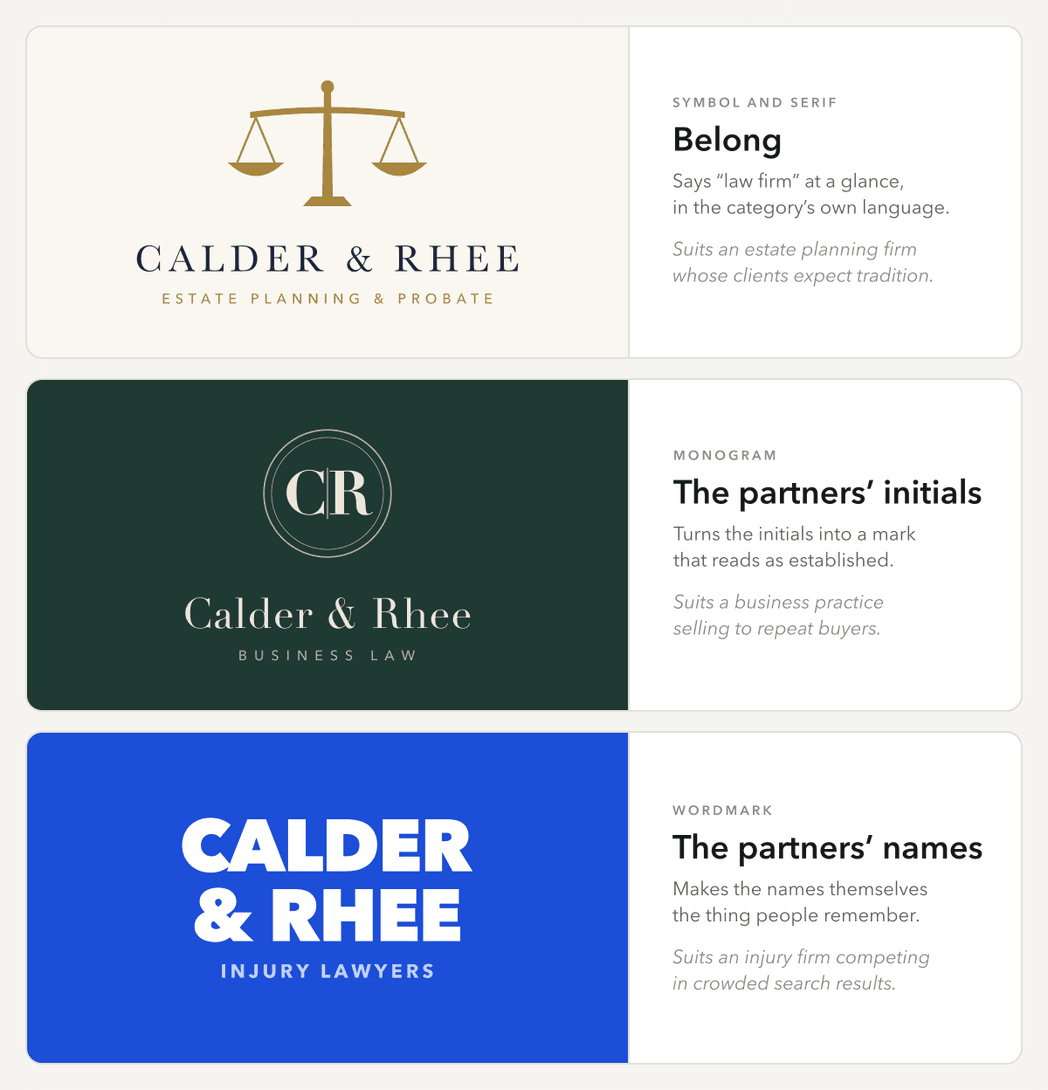
Calder & Rhee is fictional. The symbol says what the firm is. The monogram and the wordmark say who.
Four questions decide whether a symbol is doing a job for your firm.
- Does the name already say "law"? "Calder Law Group" does. "Calder & Rhee" could be an accounting firm. A symbol earns its place more when the name needs help, though a line beneath the name, like "Injury Lawyers" in the image, can do the same job.
- What do your competitors use? Search your practice area and city. If every logo in the results uses the same symbol, yours will help you belong but not stand apart.
- Does it survive avatar size? Google Business Profiles, review sites and browser tabs show a logo very small. Thin lines and fine detail are the first things to go.
- Is it drawn well? A custom, well-drawn mark reads very differently from stock clip art of the same object.
If the symbol passes, keep it. If it does not, build the mark from the firm itself: the partners' initials as a monogram, or their names as a wordmark. Either one belongs to the firm alone.
Type and color
Type and color follow the same logic. A serif with classic proportions reads as established, and a clean sans-serif reads as direct and modern. Either can be right, as long as it stays legible on a phone and the firm uses it everywhere.
Color works like the scale. Navy, burgundy, deep green and gold signal "law", so they help a firm belong and do less to help it stand apart. A consumer firm in a crowded market may want a color its competitors do not use, like the bright blue in the injury version above. A business firm may be better served by the expected palette, used with care, like the deep green of the business version. And a firm that sells a modern approach should look modern, whichever palette it chooses.
Photography
Photography is where many firms undo the rest. Stock images of gavels, handshakes and courthouse steps are the photographic version of clip art. Real photos of the attorneys and the office do more work, especially for consumer clients deciding whether they can talk to this person. One headshot style across the whole firm makes it read as one firm.
A strong look buys the firm a few more minutes of attention. What the client reads in those minutes is the other half of the brand.
The Expertise Half: How the Firm Proves It
Expertise lives in words: practice pages, attorney bios and anything the firm publishes. Here are two rewrites that show the difference, both for the same fictional firm.
A consumer practice page
Before:
Calder & Rhee is a full-service personal injury firm dedicated to fighting for the rights of injured clients. Our experienced attorneys have the knowledge and dedication to get you the compensation you deserve.
After:
We represent people hurt in car, truck and motorcycle crashes. Most of our cases involve a commercial vehicle, or an insurer that has denied or delayed a claim. Your first consultation is free, and you will speak with an attorney, not a call center.
The first version could belong to any firm. "Experienced" and "dedicated" are claims every competitor makes, and the outcome promise is the kind the advertising rules caution against. The second names the kinds of cases, which is the experience clients look for first. It answers the free consultation question, which 32% of clients now look for. And it is written plainly, which 30% of clients weigh too.
A business attorney bio
Before:
Nora Calder is a partner at Calder & Rhee. She earned her J.D. in 2009 and is admitted to practice in Louisiana and Texas. Her practice focuses on commercial litigation.
After:
Nora Calder represents regional banks and credit unions in lending and collection disputes, from the first demand letter through trial. She appears in state and federal courts in Louisiana and Texas, and writes regularly on changes to Louisiana lending law.
The first version leads with the résumé. The second leads with who she represents and in which matters, which is what a general counsel scanning bios is checking. The credentials still belong on the page, after the substance.
The bio is where clients go to check experience, so it deserves the same care as the home page.
Attorney bio content: best practices
- Open with what the attorney does, and for whom. One plain sentence, before any history.
- Name the kinds of matters handled. "Lending disputes for regional banks" says more than "commercial litigation".
- Include representative matters where the rules allow, with the context your bar requires.
- Write for the client. Consumer bios should sound like a person. Business bios should show knowledge of the client's industry.
- Use one headshot style for the whole firm. The same background, framing and light.
- List education, bar admissions and courts after the substance, not before it.
- Make contact direct, with a phone number and email on the page.
- Link to the practice pages the attorney works in, so the bio and the practice support each other.
Every bio at the firm should follow the same structure, so that ten attorneys read as one firm.
What the Best Law Firm Branding Has in Common
Put the two halves together, and the best law firm branding tends to share five traits.
- It looks current and consistent. The website, bios, letterhead, email signatures and directory listings all look like one firm, and like a firm that is active today.
- Experience is easy to find. Practice pages and bios name specific matters and client types.
- Reputation is visible. Reviews, recognitions and bar involvement appear where people decide, within the advertising rules.
- The language is plain. The website is a client's first sample of how the firm communicates.
- The next step is obvious. If the firm offers a free consultation, it says so clearly.
Branding a Law Firm: How It Runs
Whether it is a first brand, a refresh or a rebrand after a name change, branding a law firm runs in the same order.
- Start from your own client data. How did your last 50 clients find you? Most intake forms already ask. The answer tells you whether the brand is mostly confirming referrals or competing in search.
- Find the weaker half. Look at the site the way a new client would. Does it look current? Does it prove experience in your main practice areas?
- Look at the field. Search your main practice areas in your city and note what every firm says, so you know what will not set you apart.
- Decide what the brand has to prove. Usually one or two specific kinds of expertise, in plain words every partner agrees with.
- Settle the name before design. If it is changing, check it against your state's rules first.
- Design the mark, color and type together, and test them where they will live: a bio page, a business card, a profile avatar.
- Rewrite the practice pages and bios in the new voice.
- Launch everywhere at once, with a short brand guide so staff and future vendors apply it the same way.
Common reasons to start are a partner joining or leaving, a merger, a new practice focus or a move into a new market.
Branding and the Ethics Rules
Every one of those steps happens inside the rules on lawyer advertising. The ABA's Model Rule 7.1 says a lawyer must not make a false or misleading communication about the lawyer's services. Its commentary makes two points that matter for branding. Firm names and letterhead count as communications. And reporting past results can mislead if it suggests the same outcome for every client.
States adopt their own versions. Louisiana, for example, requires firm websites to list the jurisdictions the firm's lawyers are licensed in and at least one office location. None of this is legal advice, and the firm's own review has the final word. A designer should leave room for the required language and never write an outcome claim without the firm's sign-off. More on law firm websites and the rules.
Choosing a Law Firm Branding Agency or Designer
If you bring in help, the two halves are a good way to judge who you hire. The same questions apply to a law firm branding agency or an independent designer.
- Will you start from our clients? Ask how they will learn where your clients come from and what they look for.
- Will you work on both halves? A logo covers only the look. Ask whether practice pages and bios are part of the work.
- Will you show the brand at real sizes? Ask to see it as a profile avatar and on a phone, not only on a white page.
- Do you know the advertising rules? Not as legal advice, but well enough to design around them.
- Will we own everything? Every file, in every format, once the work is paid for.
Where to go from here
If your firm does one half well and not the other, I would love to hear about it. I work with firms anywhere and usually meet New Orleans firms in person. Tell me about your firm, or see how I approach brand identity.
Questions People Ask
The Services Behind This
Law Firms
I am a law firm website designer who also builds the site. Modern, custom websites and brands for small and mid-size firms, with clients from a mass tort firm in New Orleans to a defense firm in Colorado.
Brand Identity
Logos, color and type, and the rules that hold them together, from a brand designer who also builds the website. For businesses whose work is better than their brand.
Is your firm's brand showing its experience?