

Law Firm Website Design
I am a law firm website designer who also builds the site. Modern, custom websites and brands for small and mid-size firms, with clients from a mass tort firm in New Orleans to a defense firm in Colorado.
What a Law Firm Site Is For
For a lot of firms, the people who land on the site already have your name. A referring attorney gave it to them, or an adjuster, or a past client. So the site’s first job is to confirm what they were told.
At McLetchie, Bradley & Fowler, a civil-litigation defense firm, we called that the credibility layer: the trust signals a referral checks before calling. So the brand had to look like a firm you would trust with a case, without a single gavel on it. A modern law firm website needs the same restraint.
Other firms need new clients from search. Murray Law Firm is known for high-stakes mass tort work, on a site that had not been redesigned in fifteen years. The rebuild added a real inquiry form. Traffic went from 300 pageviews in the new site’s first four months to about 1,000 a month within its first year.
A Designer Instead of an Agency
An agency splits a firm’s website across an account manager, a designer and a developer. Every handoff loses a little of how the firm actually works.
When you hire me, the person asking the partners questions is the person designing the pages and writing the code. Every site is custom, built in WordPress or Next.js, and never a template with your logo dropped in.
What Goes on a Law Firm Website
Most of what a firm needs is content, not decoration. A page for each practice area, written so a potential client recognizes their own problem in it, strong enough to work as a landing page on its own. A bio for every attorney. And an inquiry form that asks enough to tell a real case from a wrong number, short enough to fill out on a phone.
The attorneys know their practice areas, so the first draft of that copy comes from the firm. I refine it so it reads clearly and sounds like the firm, without describing a practice area beyond what you gave me. Your own review has the final word.
Small Firms and Bigger Ones
A small firm’s site has one job, which is to get a qualified person to call. That takes a clear practice area, proof the firm is real, and a form that asks the right questions. For a solo practice, the whole site can be a single page.
A bigger firm needs a system more than a page. At Duplass, about thirty attorneys, every bio now follows the same structure. So a referral who looks up one attorney finds what they need in the same place every time.
What Changes for Legal
Referrals look up the attorney as well as the firm. So the attorney pages carry as much weight as the homepage, and each one has to answer the same questions in the same place.
Attorney advertising is regulated by the state bar. I design with room for the disclaimers your firm uses, and your own review of the copy has the final word.
Louisiana adds a rule of its own. Under Rule 7.6, a firm’s site has to list every jurisdiction its lawyers are licensed in, and at least one real office location. So for firms here, those disclosures go into the layout from the start, not into a footer at the end.
Some firms need pages in a second language. I have shipped a site in four languages for an insurance agency, so that is not new territory.
What I Do for Firms
Work for Law Firms
Murray Law Firm and Duplass are in New Orleans, where I am based.
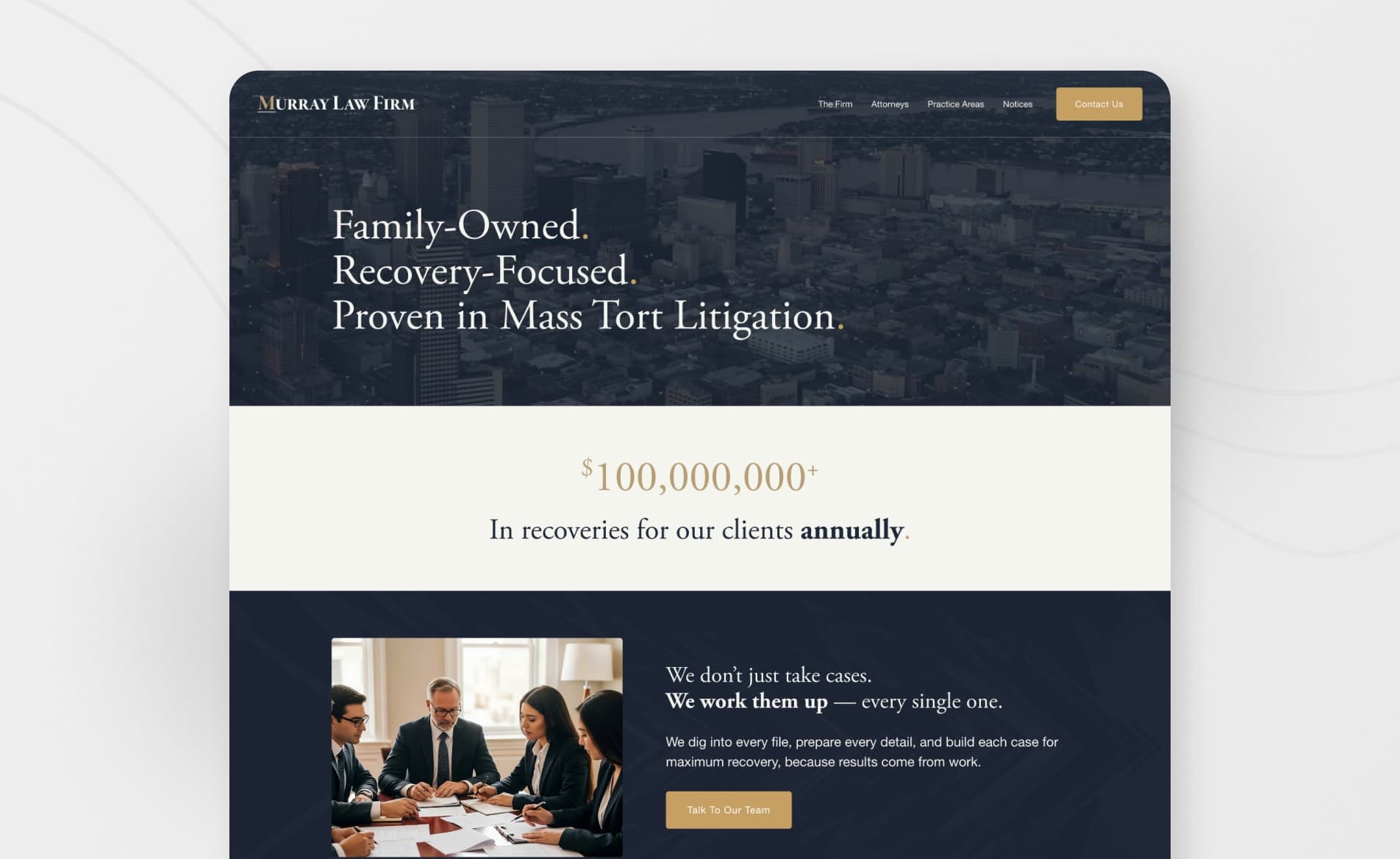
Murray Law Firm
2025
WebsiteWebsiteLegalLegalSquarespaceSquarespaceA New Orleans mass tort firm’s site, rebuilt from the brand up.

McLetchie, Bradley & Fowler
2026
Brand IdentityBrand IdentityLegalLegalWhite-LabelWhite-LabelA defense firm’s identity, drawn out of a partner who could only name what she hated.
“Jacob has helped me, and other law firms as well, with social media posts, client handouts and proposals, and website design edits, among other ad-hoc requests. He has always been wonderfully professional, extremely responsive, and helpful with new ideas.”
Questions People Ask
Explore Services
Has the firm outgrown its website?