

Law Firm Website Tips: What Makes a Good Law Firm Website
A good law firm website answers the first questions a potential client has: do you handle cases like mine, can I trust you, and what happens if I call? It makes calling easy on a phone, and it leaves room for the rules on lawyer advertising.
A Client Is Deciding Between You and Two Other Firms
Picture someone who has just been hurt at work, or served with papers, or told a parent's estate is a mess. They have your firm's name from a friend, and two more from a search. They open all three on a phone, probably at night, and they give each site a few seconds.
What they are looking for is simple. Do you handle cases like theirs? Can they trust you? And what happens if they call? A good law firm website answers all three before the visitor has to scroll. Many sites answer none of them on the first screen.
These law firm website tips are built on what clients say they look for, from Clio's research, and on the rules every firm's website has to follow. There is a worked example of one firm's first screen, before and after, and a checklist to hold your own site against.
The Short Answer
- Say what you handle and where, first. Clients choose on experience with cases like theirs, so the first screen should name the practice and the place.
- Design for a phone. Put tap to call at the top, and keep the form short.
- Say what happens next. A three-step explanation of the first call takes the fear out of reaching out.
- Prove experience on the practice pages and bios. That is where clients look for it.
- Leave room for the rules. Lawyer advertising rules, and some states' website requirements, belong in the layout from the start.
- Get the groundwork right. Clear page titles, a sensible structure and Search Console set up at launch help search engines understand the site.
What Clients Look for in a Law Firm Website
Before designing anything, it helps to know how people actually choose a lawyer. Clio's 2025 Legal Trends Report asked clients what they looked for. The top answers were experience with cases like theirs (48%), a reputable firm (44%), positive reviews (33%), a free consultation (32%) and clear, concise communication (30%).
Referrals still bring in the most clients, but many referred clients look the firm up before they call. So the website gets a vote either way. The law firm branding guide breaks down how clients find a lawyer.
So what makes a good law firm website is not a clever design. It is a site that shows experience with the visitor's kind of case, shows the firm is reputable, and makes the next step clear. Everything below follows from that.
A Worked Example: The First Screen on a Phone
Here is a fictional firm's homepage as it first loads on a phone, before and after. The firm and every detail are made up. Look at what a visitor learns in the first few seconds.
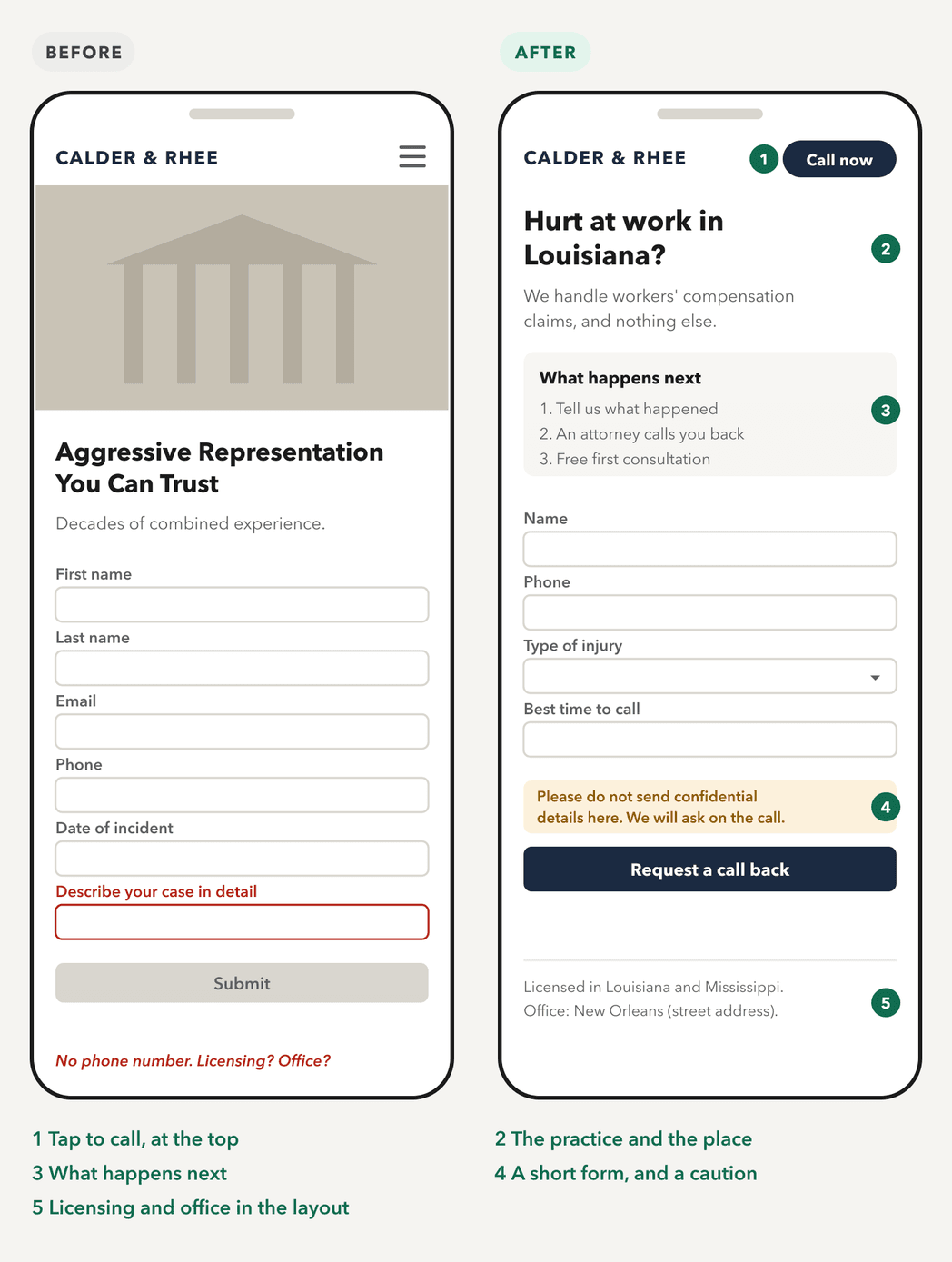
Each numbered choice has a job.
- Tap to call, at the top. Many clients would rather talk than type, especially when something is urgent. On a phone, the call button should never be more than a thumb away.
- The practice and the place. "Hurt at work in Louisiana?" tells the right visitor they are in the right place. It signals experience with cases like theirs, which clients look for most. The courthouse photo and the slogan said nothing a visitor could use.
- What happens next. A frightened client does not know how a first call works. Three short steps answer that, and they mention the free consultation, which a third of clients look for.
- A short form, and a caution. Name, phone, the type of injury and a good time to call is enough to start, and enough for the firm to tell a real case from a wrong number. The old form asked visitors to describe their case in detail. Firms often ask people not to send confidential information through a website form, because nobody has agreed to represent them yet. Ask your own ethics counsel how your firm should handle it.
- Licensing and office in the layout. Some states require a firm's website to show certain information. Here it sits in a designed spot, instead of being squeezed in at the end.
The before version is not ugly. It just makes the visitor work for every answer, and on a phone at night, most will not.
Law Firm Website Content That Earns the Call
Law firm website content does two jobs: it shows experience, and it makes the firm feel safe to call. Most of it lives on four kinds of pages.
- Practice area pages. One page per area you actually handle, written for the client's situation, not for other lawyers. Explain what usually happens, how long it can take and what the client should do now. The attorneys know this best, so they should draft it, and a designer or editor can make it easier to read.
- Attorney bios. Clients use bios to check experience. Lead with the kinds of matters the attorney handles, not their law school. The law firm branding guide has a worked bio rewrite.
- Proof. Reviews, published articles, speaking and representative matters, all within your state's rules on results and testimonials.
- Contact and next steps. Hours, an office address, the phone number, and what happens after someone gets in touch.
Good attorney website content is plain. A client who has never met a lawyer should be able to read a practice page and know whether to call.
Law Firm Mobile Website Design
Most of the advice above comes back to one screen: a phone. Law firm mobile website design is less about shrinking the desktop site and more about deciding what goes first.
- The phone number is a button, and it stays visible as the visitor scrolls.
- The first screen names the practice and the place, with no slider or full-screen photo pushing it down.
- Forms are short, with fields large enough to tap, and a clear message once they are sent.
- Text is large enough to read without zooming, and contrast is strong.
- The site loads fast on a phone connection. A heavy video hero is a common cause of a slow law firm homepage.
Test it on a real phone, on a cellular connection, before launch. It is the fastest way to see what a client sees.
The Rules on Lawyer Advertising
A law firm's website is a communication about the firm's services, so the rules on lawyer advertising apply to it. The ABA's Model Rule 7.1 says a lawyer must not make a false or misleading communication about the lawyer or the lawyer's services. Its commentary warns that reporting past results can mislead, if it suggests the same outcome for every client.
States adopt their own versions, and some add website rules of their own. Louisiana's Rule 7.6, for example, requires a firm's website to list every jurisdiction its lawyers are licensed in and at least one real office location.
For the website, that means three things. Leave room in the layout for required information, so it is designed instead of squeezed in. Never let a designer write a results claim or a testimonial without the firm's review. And have the firm's own review, or its ethics counsel, sign off before launch. This article is not legal advice, and the firm's own judgment has the final word.
The Groundwork Search Engines Need
A site can say all the right things and still be hard for search engines to understand. This groundwork is part of building the site properly, and it is easier to get right at launch than to fix later.
- One page per practice area, with a clear address like /practice-areas/workers-compensation.
- A unique title and description for every page, naming the practice and the place, the way a client would search.
- Headings that follow the page's structure, with one main heading per page.
- Structured data that describes the firm, its office and its attorneys in a format search engines read. Schema.org has types for legal services and attorneys.
- Search Console set up at launch, with the sitemap submitted, so you can see which pages are indexed and fix any that are not.
- Speed checked on a phone, with images sized for the screen.
None of this guarantees a ranking. What it does is make sure nothing about the site itself stands in the way. If a new site is not showing up at all, this guide to getting a website on Google walks through the fixes.
Law Firm Website Best Practices: A Checklist
Here are the top features to look for in a law firm website, in one place. Hold your own site against it.
- The first screen names the practice and the place.
- Tap to call is visible at the top on a phone.
- A short "what happens next" explains the first call.
- Each practice area has its own page, written for clients.
- Bios lead with the matters each attorney handles.
- Reviews and proof follow your state's rules.
- The contact form is short and cautions against confidential details.
- Required disclosures are part of the layout.
- Every page has its own title and description.
- Search Console is set up, and the site is fast on a phone.
When to Bring In Help
A solo attorney with one practice area can often do a lot of this alone. A well-chosen template, a short form, a clear first screen and an honest bio go a long way.
It is time to bring in a designer when:
- The firm has several practice areas or offices, and the structure needs planning.
- The site is a main source of new matters, so a slow page or a broken form costs cases.
- The brand looks dated next to the firms clients compare you with.
- You need intake connected to your practice management software, so inquiries do not get lost.
Whoever you hire, ask them these questions.
- How will the site look and work on a phone, and will you test it on one?
- Who drafts the practice-area content, and how will you help us make it readable?
- How will you make room for the disclosures our state requires?
- Will every page have its own title and description, and will Search Console be set up at launch?
- Will we own the site, the domain and every file?
Where to go from here
If your firm's site makes clients work for the answers, that is the kind of project I take on. For Murray Law Firm, a mass tort firm, I rebuilt a site that had not been redesigned in fifteen years and added a real inquiry form. Traffic went from 300 pageviews in the new site's first four months to about 1,000 a month within its first year. Your attorneys draft the practice content, and I refine it, design the site around it and build it, with the required disclosures in the layout from the start. See how I approach law firm websites, or tell me about your firm.
Questions People Ask
The Service Behind This
Is your firm's website easy to act on?