

Restaurant Branding: What the Research Says Matters to Guests
Every restaurant needs a brand, because guests meet it on social media, in listings, on the street and in the room. Research on how guests find restaurants, and on how expectations change taste, shows why those four have to match.
Every Restaurant Needs a Brand
Search for restaurant branding and you will find agencies offering brand strategy, mission statements, interiors and uniforms. That can make branding sound like a project for restaurant groups. It is not.
Every restaurant has a brand, because every guest meets it somewhere first. It might be an Instagram post, a Google listing, the sign on the street or the room itself. Branding a restaurant means making all four feel like the same place. So when someone walks in, they get the experience the other three led them to expect.
This guide covers four findings from research on how guests choose restaurants and how they experience food. Each one shows why that consistency matters, and what it takes.
The Short Answer
- Guests find restaurants through people and places first. In a 2025 Toast survey of US adults, 38% found new restaurants through word of mouth and 30% by walking or driving past. So the name and the sign do much of the work of bringing in new guests.
- Names that are easy to say feel safer. In a 2009 study, made-up food additives with hard-to-pronounce names were rated as more harmful. A restaurant name has to survive being said out loud.
- What guests expect changes what they taste. Preschoolers preferred identical food when it came in McDonald's packaging. Adults rated the same wine as more pleasant when they were told it cost more.
- So the look has to match the food and the price. Guests judge both before they arrive, and much of what they judge from is the brand.
- The brand has to match in four places. Guests move between social media, online listings, the street and the room, and each should look like the others.
Finding 1: Guests Hear About You or Walk Past You
A brand can only work once a guest has met it. Toast asked 1,466 US adults in October 2025 how they found new restaurants.
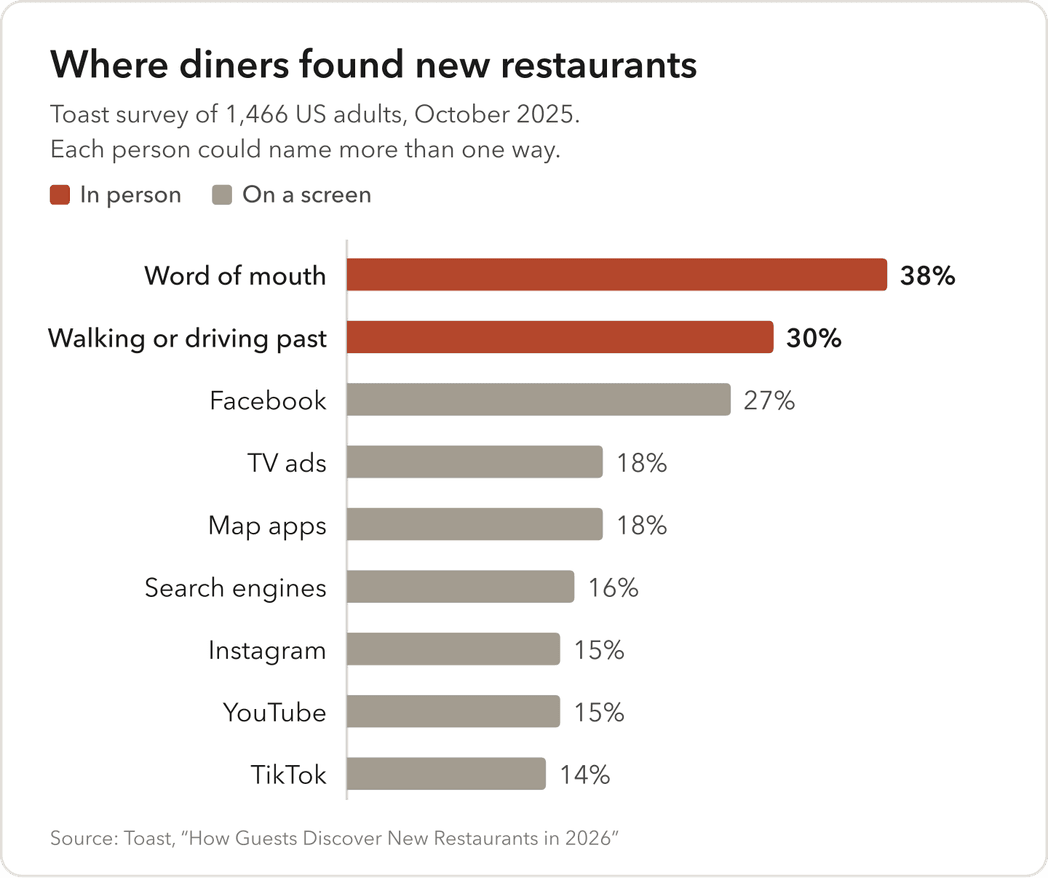
Word of mouth and walking past lead. Facebook is next, at 27%, and every other channel, from map apps to TikTok, sits at 18% or below. The mix shifts with age, and for Gen Z, TikTok was the top channel, at 38%.
So many new guests meet a restaurant as a name someone says or a sign they pass. Many then look it up on a map, in a search or on Instagram. Google's own help pages say an exterior photo helps customers recognize a business when they visit, which is the sign doing its job online.
Regulars run on the same recognition. In DoorDash's 2026 survey of 3,001 US consumers, 80% of dine-in visits were to restaurants the guest had tried before. So the logo on the sign and the menu should be the same one guests see on Instagram, Google, Yelp and the booking and delivery apps.
Finding 2: Names That Are Easy to Say Feel Safer
Word of mouth is the top way guests find a restaurant, so the name is often heard before it is read. That makes how it sounds part of the brand.
In a 2009 study in Psychological Science, people rated made-up food additives as more harmful when their names were hard to pronounce. The researchers traced it to novelty. A hard name feels unfamiliar, and unfamiliar feels risky.
The same study found a twist. Amusement-park rides with hard names seemed more likely to make people sick, and also more exciting. So an unusual restaurant name can still work. But it has to survive the way restaurant names travel, which is by being said across a table and typed into a phone later.
Four checks before you commit to a restaurant name:
- Say it out loud to someone. Then ask them to spell it back. If they cannot, they will struggle to find it in a search.
- Search it in your city. Check Google and Maps for another restaurant, bar or food truck nearby with the same name or one close to it.
- Check the handle and the domain. The Instagram name and the web address should match the name, or come close.
- Check the trademark register. The US Patent and Trademark Office has a free trademark search. It is a starting point, not legal advice. A trademark attorney can run a proper clearance search before you build a sign around the name.
Finding 3: What Guests Expect Changes What They Taste
This is where the look earns its place. In a 2007 Stanford study, 63 preschoolers tasted pairs of identical foods and drinks, one in McDonald's packaging and one in plain packaging. On average, they preferred the branded versions. In a 2008 Caltech study, adults rated the same wine as more pleasant when they were told it cost more, and their brain scans moved with it.
Those are two studies, one with young children and one with wine in a lab. But a 2015 review in Food Quality and Preference gathered many more like them, from labs and from restaurants, canteens and bars. It collects studies in which cues outside the food changed how the food tasted.
So the brand is not decoration on top of the meal. It sets the expectation the food is tasted against. The colors, type and photos a guest sees online are a preview of the room, and they work best when they come from it.
That cuts both ways. A look that promises a fancier night than the room delivers sets the guest up to be let down. A look that undersells the food keeps away the guests who would love it.
Finding 4: Guests Judge Price and Quality Before They Arrive
Once a guest knows the name, the next question is whether to go. The same Toast survey asked what turned a discovery into a visit. Price and value came first, at 55%, then food quality at 51%. Menu variety and location followed at 43% each.
A guest judges much of that from a phone, from the menu and the photos. So the menu should say what is on the plate and what it costs, in the same type and colors as the sign. "Grilled to perfection" could be on any menu. "Grilled over oak" belongs to one kitchen. And the photos should show your own food, in your own light.
Why the look of a restaurant's website matters covers a study on what makes food photos look appetizing. How to put the menu online covers why it should be text, not a PDF.
Four Places the Brand Has to Match
Put the four findings together and they point to the same job. Guests meet a restaurant in four places, often in a row, and the brand has to hold together across all of them.
| Where guests meet it | What they see | What to check |
|---|---|---|
| Social media: Instagram, Facebook and TikTok | The profile picture, the bio and the photos | The logo reads as a small circle, and the photos show your own food and room |
| Your website and listings | The name, the logo, photos, hours and the menu | The name and logo match the sign, and the menu and hours are current |
| The street | The sign, the windows and the door | The sign reads from across the street, after dark |
| The restaurant itself | The room, the menu, the plates and the staff | The colors, type and menu match what guests saw before they came |
Listings here means every place that shows your name, hours and menu. That includes Google, Apple Maps, Yelp and Tripadvisor, a reservation page on Resy, OpenTable or Tock, and delivery apps such as DoorDash and Uber Eats. Your website is the source they should all agree with.
All four run on the same pieces, which are one name, one logo, colors and type taken from the room, real photos and one menu. Use each the same way everywhere.
Logo design for a restaurant
A fork, a chef's hat or a slice of pizza can work. It says "restaurant" at a glance, which helps when the name does not. It will not set you apart from neighbors that use the same symbol, so look at the signs on your block first.
Whatever the mark, test it as a small circle, because Instagram, Facebook, Google and the delivery apps all show it that way. Then test it in one color, because it will be stamped on bags and printed on cups.
How Much Does Restaurant Branding Cost?
Studios that publish prices disagree widely. As of November 2026, one studio's guide puts a freelance logo alone at $500 to $3,000. Another says restaurant branding usually costs between $5,000 and $150,000. These figures change often, and they are the studios' own estimates.
What moves the price is mostly scope:
- Naming. Finding and checking a name adds research and time.
- How many pieces there are. A logo and a menu cost less than a full set of signs, menus, packaging and uniforms.
- Whether the website is included. Some studios design the brand and hand off files. Others design the brand and the site together.
Ask every designer to quote the same list, item by item, so the quotes can actually be compared.
When to Bring In Help
A new counter spot can open with a clean wordmark, a well-made sign and a menu in the same type. A logo maker can be a start for a pop-up or a food truck while the concept is still changing.
Bring in help before the sign is made and the menus and packaging are printed. They all wait on the logo, and they are hard to change later. Help is also worth it when an open restaurant's look no longer matches its food or its prices.
Three questions for whoever you hire:
- Will you start from our room and our guests? The brand should come from the place itself.
- Will you show us the logo at real sizes? As a profile picture, on a sign and in one color, not only on a white page.
- Will we own every file? In every format, once the work is paid for.
Where to go from here
If you are opening a restaurant, or your brand no longer matches the room, I would love to hear about it. I design the brand and the site together, so they feel like one thing from the start. If you already have a brand, or a studio is making one, I build from their files. See my restaurant website design package and how I approach brand identity, or tell me about your restaurant.
Questions People Ask
The Services Behind This
Restaurants
Restaurant website design with your Google Business Profile, reviews and listings handled as one job, and a site your team can edit.
Brand Identity
Logos, color and type, and the rules that hold them together, from a brand designer who also builds the website. For businesses whose work is better than their brand.
Is your brand showing guests the room?