

Website Maintenance Cost: What It Takes to Keep a Site Running
A website's fixed running costs are small and easy to price: a domain, hosting and a few subscriptions. The real cost is the care work, meaning updates, backups and fixes. How the site is built decides how much of that there is.
The Site Is Built. Now It Keeps Costing Something
A website is not a one-time purchase, even when it feels like one. The domain renews. The hosting renews. Plugins send update notices. And one day a form stops sending leads, and someone has to find out why.
Search for website maintenance cost and you will find monthly ranges that disagree with each other, often from companies selling a maintenance plan. So it helps to split the cost in two. There are fixed running costs, which are small and easy to price. And there is care work, which is where the real money and the real risk sit.
This guide prices the first half at the vendors' own pages, explains what the second half includes, and shows how the way a site is built changes both.
The Short Answer
- Fixed running costs are small. As of November 2026, a .com domain at Porkbun was $11.81 a year, and hosting ran from about $2.50 to $28 a month, depending on the plan.
- Care work is the real cost. Updates, backups, security, fixes and small edits take time every month, whether yours or someone else's.
- Hourly rates vary widely. In Clutch's 2026 pricing guide, US web design agencies charged $100 to $149 an hour, and agencies working on platforms like WordPress or Wix charged $25 to $49.
- A care plan pays when the work is regular. It does not pay when you are paying for updates nobody runs.
- The build decides the care bill. A site with fewer moving parts needs less upkeep.
What It Costs to Keep a Site Running
These are the costs a site carries just by existing. They are worth listing first, because they are the easiest to check and the easiest to cut.
| Running cost | Example | Price |
|---|---|---|
| Domain | A .com at Porkbun | $11.81 a year |
| Budget hosting | Hostinger shared hosting | $2.49 a month on a four-year plan, renewing at $10.99 |
| Managed WordPress hosting | WP Engine Essential | $336 a year, billed annually |
| Premium plugin | Yoast SEO Premium, one site | $118.80 a year |
| Stock photos | Adobe Stock, 10 assets a month | $29.99 a month, on an annual plan |
| Website builder | Wix or Squarespace | $17.77 to $159.77 a month on Wix, $19 to $99 on Squarespace, billed yearly |
Each price comes from the vendor's own page, as of November 2026. These prices change often, so check them again before you budget.
Here is what a year looks like for three common setups.
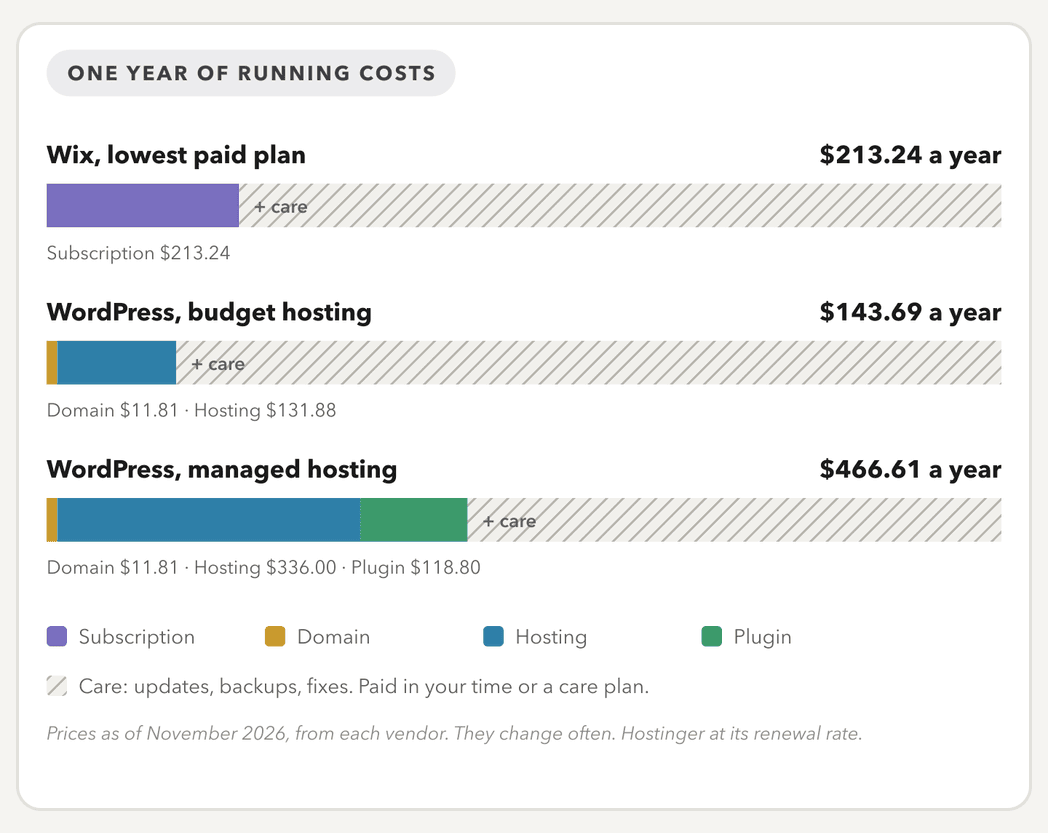
Each choice in the image is deliberate.
- Only real prices. Every number is a vendor's listed price, and the totals are simple sums.
- Hosting at its renewal rate. Introductory prices end. Budgeting at the renewal rate avoids a surprise in year two or five.
- Care left unpriced. It is drawn as a hatched segment with no number, because it is paid in time or in a plan, and it varies more than any other cost.
- The cheapest row is not the cheapest site. The budget WordPress row costs least in fixed costs, and can cost most in care if nobody keeps it updated.
What Does Website Maintenance Include?
Care work is everything that keeps a site safe, working and current. Here is what it covers, and roughly how often.
- Updates. The CMS, the theme and every plugin, often several times a month on WordPress. Each one is small, and skipped updates are a common way sites get hacked.
- Backups. Automatic, daily or weekly, stored somewhere other than the server, and tested now and then by actually restoring one.
- Security and uptime. Watching for downtime, malware and expired SSL certificates.
- Form and email checks. Making sure contact forms still reach someone. A broken form costs leads silently.
- Speed and Search Console. Checking now and then that pages load quickly and that Google is not reporting errors. If pages are missing from Google entirely, this guide walks through the fixes.
- Content edits. New staff, new services, new hours and new photos.
- Renewals. Domain, hosting and plugin licences, before they lapse.
On a small site, most months this is an hour or two. The months it is not are the ones where something broke.
Website Care Plan: When It Pays
A care plan is a monthly fee for some or all of the work above. It can be good value, or it can be a fee for updates nobody runs. The difference is in what it covers.
A care plan usually pays when:
- Your site runs on WordPress with many plugins, so updates are constant and one can break the site.
- Nobody on your team wants to own it, and a lapse in updates or renewals would go unnoticed.
- The site brings in leads or sales, so downtime has a real cost.
- You edit content often, and a plan includes those edits.
It usually does not pay when the site is small, rarely changes, and runs on a platform that handles updates for you. On Wix or Squarespace, the subscription already covers hosting, security and platform updates, so a care plan is mostly content edits.
WordPress Website Maintenance Cost
WordPress is free, and that is part of why its upkeep varies so much. You choose the hosting, the theme and the plugins, and every choice brings its own updates.
A WordPress site built from a theme and a stack of plugins is the most work to keep running. Every plugin is code from a different author that has to be updated and can conflict with the others. Plugin licences also renew every year, and premium ones add up.
A WordPress site built as a custom theme, with few plugins, needs far less. There is less to update, less to conflict, and fewer licences to renew. The same is true of a site built in code and hosted as static files, where there is very little server software to patch at all. How the common platforms compare covers the trade-offs in more detail.
How the Build Changes the Bill
The biggest lever on small business website maintenance is not the care plan. It is how the site was built.
- A builder site on Wix or Squarespace has its upkeep handled by the platform, and you pay for that in the subscription, for as long as the site exists.
- A plugin-heavy WordPress site costs little to host and a lot to look after, because every plugin is another thing to update.
- A site built as a system, on a custom theme or in code, costs little to host and little to look after, because there are few moving parts and edits happen in fields that cannot break the layout.
BIA, an insurance agency site I built, is a static site on Cloudflare Pages, so the agency pays nothing to run it.
So when a site needs constant fixing, the cheapest fix is sometimes a rebuild. The redesign guide covers when that makes sense.
When to Bring In Help
You can run most care work yourself. Turning on automatic backups, checking forms once a month, renewing on time and applying updates on a small site take little time once they are a habit.
It is time to bring in help when:
- Updates break things, so you have stopped running them.
- The site has been hacked before, or you are not sure it is clean.
- Nobody knows where the logins are for the domain, hosting and plugins.
- The site brings in leads, and nobody is checking that the forms still work.
Whoever you hire, ask them these questions.
- Exactly what is included each month, and what is billed separately?
- How often do you update, and do you test the site after each update?
- Where are backups stored, and when did you last restore one?
- Who owns the domain, the hosting account and the plugin licences?
- If we stop the plan, what happens to the site and our access?
Where to go from here
If your site needs constant fixing, the fix may be in how it was built. I build sites as systems with few moving parts, so there is less to update, less to break and less to pay for each year. For the sites I build, a care plan covers the updates, backups and security that remain. See how I approach website design, or tell me about your site.
Questions People Ask
The Service Behind This
Tired of a site that needs constant fixing?