

How Diners Choose Restaurants: What Nine Surveys Agree On
Restaurant surveys often disagree because they ask different questions. Side by side, nine recent US surveys agree on more than their headlines suggest. Diners hear about a restaurant first, check its menu and reviews online, and choose mostly on price, food and location.
Every Restaurant Survey Has a Sponsor
Search for how diners choose restaurants and most of the numbers come from companies that sell to restaurants. Toast sells point-of-sale systems. DoorDash runs delivery. Menufy sells online ordering. Each one publishes its own survey of restaurant consumer behavior and cites its own figures.
That is not a reason to ignore them. Most were run by research firms such as Nielsen and Dynata, with samples from about 750 to 8,000 people. But each one asks its own questions, so the numbers rarely line up. One survey finds 16% of diners discover restaurants through search. Another finds 64% always or often search Google before choosing a new one.
This report puts nine recent US surveys side by side, with who paid for each and what it asked. Where they agree, the finding is strong. Where they disagree, the question usually explains why. It also lists the restaurant customer statistics nobody has measured yet.
The Short Answer
- Diners hear about a restaurant first, then check it. Word of mouth, at 38%, and walking or driving past, at 30%, lead Toast's list of how people found new restaurants. In TouchBistro's survey, 85% always or often look at the menu online before choosing a new restaurant, and 64% search Google.
- When AI suggests a place, diners still check. In Menufy's survey, 2% would order from an unfamiliar restaurant an AI tool suggested without checking another source first.
- Price leads the reasons diners give. Value or price came first for YouGov (63%), Toast (55%) and Reputation (51%). US Foods put location (73%) a point ahead of cost (72%).
- Food matters most to whether guests recommend you. In a survey of 8,000 adults analyzed at Northwestern, food was the strongest predictor of recommending a restaurant. At full-service places, ambiance came second.
- Reviews have the strongest evidence. Two-thirds or more of diners check them, depending on the survey. A Harvard Business School study found one extra Yelp star brought independent restaurants 5 to 9% more revenue.
- Most visits are to familiar places. In DoorDash's survey, 80% of dine-in visits were to restaurants the guest had tried before.
The Nine Surveys, and Who Paid for Them
Every survey here covers the US, dates from 2023 or later and states its sample, except YouGov's. Each was read at its source in November 2026. Two older studies appear as labeled context. One is the only study here that measures revenue, and the other is a peer-reviewed study from outside the US.
| Survey | What the sponsor sells | Fielded | Who answered | Run by |
|---|---|---|---|---|
| Toast, guest discovery survey | Restaurant point-of-sale | Oct. 2025 | 1,466 US adults | Panel providers |
| TouchBistro, Diner Trends Report | Restaurant point-of-sale | Sept. 2023 | 1,500 US diners | Maru/Matchbox |
| Reputation, dining survey | Review and listing software | Aug. 2025 | 763 US adults who visited a hospitality venue in the past six months | Nielsen |
| DoorDash, Industry Trends Report | Delivery and restaurant software | March 2026 | 3,001 US consumers | Dynata |
| BrightLocal, Consumer Review Survey | Local marketing software | Published 2026 | 1,002 US adults, about all local businesses | SurveyMonkey panel |
| Menufy, AI discovery survey | Online ordering for independents | Sept. 2026 | 1,000 US adults | Dynata |
| YouGov, What Drives Diners? | Research data | Published March 2025 | Not stated | YouGov |
| US Foods, menu preferences survey | Food distribution | Sept. 2023 | 1,003 people in the US | Not stated |
| Prosper Insights, analyzed at Northwestern | Consumer research data | Nov. 2025 | 8,000 US adults | Prosper |
A sponsor is not a verdict. A point-of-sale company can run a sound survey. But it chooses the questions, so the table names who paid.
How Diners First Hear About a Restaurant
People and places come first. Toast asked US adults how they found new restaurants, and the shares add up to more than 100%, so many named more than one way. Word of mouth led at 38%, then walking or driving past at 30%. Facebook followed at 27%. Map apps came in at 18% and search engines at 16%.
Familiar places come first too. DoorDash found that 80% of dine-in visits and 79% of orders were with restaurants the guest had tried before.
AI is a newer way in. In Menufy's survey, 35% said an AI recommendation had introduced them to a restaurant they then visited or ordered from. Estimates of how many diners use AI at all vary widely, as the AI section below shows.
What Diners Check Before Choosing
Once a diner has a name, most look it up. The surveys agree on that much. They disagree on how many, and the chart shows by how much.
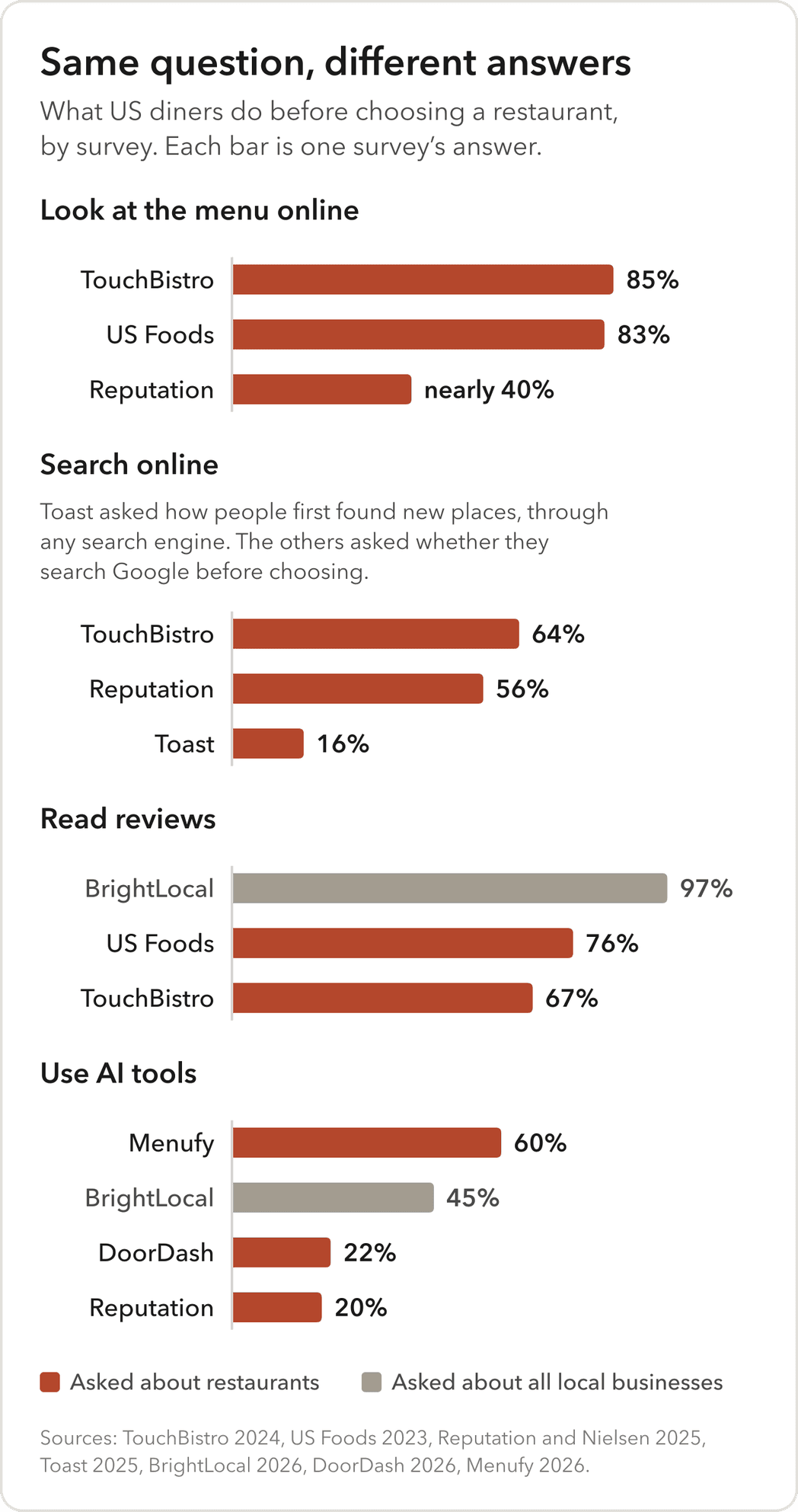
The menu is the clearest case. Two surveys fielded in September 2023 found 83% review the menu before going and 85% always or often look at it online. Reputation's 2025 survey found nearly 40%. The summaries do not give the exact wording, so this report cannot settle the gap. What is visible is the setup. TouchBistro asked about deciding on a new restaurant, and Reputation's survey covered bars as well as restaurants.
Search shows the pattern most plainly. Toast asked how people first found new places, and 16% said a search engine. TouchBistro asked what diners do before choosing a new restaurant, and 64% said they always or often search Google for it. Reputation found 56% use Google Search to research restaurants and bars. So search is how most diners check a restaurant, and how fewer of them discover one.
Even after an AI suggestion, the check happens. Menufy found 54% would look at the menu and prices, 48% at reviews and 47% at the restaurant's own website before ordering. How to put a menu online covers why the menu on a website should be text.
How Diners Choose Restaurants: Price, Food and the Room
Price leads what diners say. YouGov found value for money was the top factor, at 63%, ahead of the type of cuisine at 47%. In Toast's survey, price and value turned a discovery into a visit for 55%, just ahead of food quality at 51%. Reputation found price at 51%, food quality at 48% and service at 45%. US Foods put location first, at 73%, with cost a point behind.
Food leads what diners do afterward. Northwestern's Medill Spiegel Research Center analyzed a November 2025 survey of 8,000 US adults by Prosper Insights and Analytics. Food was the strongest predictor of whether someone recommends a restaurant. In that analysis, quality, price, portion size and taste moved together as one judgment. So diners weigh price and quality together, as one question of value.
Recommendations matter because word of mouth is the top way diners find new restaurants. At full-service restaurants, ambiance was the second strongest predictor, and food was nearly double it. At fast-food places, ambiance came last. Restaurant branding covers research on how what guests expect changes what they taste.
A 2020 peer-reviewed study of diners in Malaysia found the same order, with menu price first across restaurant types. It also found word of mouth mattered most when the meal was a celebration.
Reviews Have the Strongest Evidence
Most diners read reviews, though the share depends on the question. TouchBistro found 67% always or often check online reviews before choosing a new restaurant. US Foods found 76% look at reviews before going out. BrightLocal found 97% read reviews for local businesses, but it asked about every kind of business.
Google is the top place diners read them. In TouchBistro's survey, 43% had read Google restaurant reviews in the past three months, against 31% on Yelp. BrightLocal's 2026 survey shows other places gaining. Google fell from 83% to 71% as a source of reviews for local businesses, while Apple Maps rose from 14% to 27%.
Reviews also have the strongest evidence behind them. Every other figure in this report comes from a survey of what people say they do. A Harvard Business School study instead matched Yelp ratings to Washington State revenue records. One extra star brought independent restaurants 5 to 9% more revenue, and chains saw no effect. The study is more than a decade old, and this report found no newer one that measures revenue this way.
Estimates of AI Use Run From 20% to 60%
Each survey asked about AI a little differently. Reputation found 20% use AI tools like ChatGPT to research restaurants and bars. DoorDash found 22% have used AI to help choose a restaurant. BrightLocal found 45% use AI for local recommendations of any kind, up from 6% a year earlier. Menufy found 60% use AI tools to help decide where to eat.
Those figures come from different years, panels and questions, so they do not form a trend line. Some sponsors also have a stake in the answer. Reputation's own site leads with a pitch about being the answer in AI search.
Whatever the share, an AI suggestion is a start. In Menufy's own survey, 2% would order from an unfamiliar AI suggestion without checking another source.
What No Survey Has Measured
Some common owner questions have no good answer yet. This report found no survey or study that measures:
- How many choices finish on the Google listing, without a visit to the website.
- Whether a better website design brings more bookings or revenue, measured directly. The closest evidence is the ambiance finding above, and research on how what guests expect changes what they taste.
- Whether a PDF menu loses guests that a text menu would keep.
- How tourists, or diners in any one city, choose differently from the national samples.
Treat any figure that claims to answer these with care, and ask where it came from.
What the Evidence Supports
Read together, the surveys point to a short list for an owner.
- Put the menu online, with prices. Three surveys put the menu at or near the top of what diners check, and price leads the reasons they choose.
- Keep the Google listing accurate. Most diners search Google before choosing a new restaurant, and it is the top place they read reviews. Restaurant SEO covers what to set and what to skip.
- Ask for reviews, and answer them. They are the only item here with evidence of an effect on revenue.
- Make the food and the room look like themselves. Food drives recommendations, and at full-service places the room comes next.
- Treat AI as where the search starts. Diners still check the menu, the reviews and the website before they commit.
Some of the companies behind these surveys sell tools for the newest channels, from AI visibility to online ordering. Their own numbers still put the menu, the reviews and the listing first.
How to Read the Next Restaurant Survey
Most restaurant marketing statistics you see quoted come from surveys like these. Five questions sort the useful ones from the rest.
- Who paid for it, and what do they sell? It does not make the survey wrong, but it shapes what was asked.
- What exactly was asked? "How did you discover it" and "what do you check before choosing" give very different numbers.
- Was it about a new restaurant, or any visit? Most visits are to places diners already know, so the two give different pictures.
- Who answered? Restaurant diners, or customers of every kind of local business.
- When was it fielded? The AI figures in particular change fast.
When to Bring In Help
An owner can act on most of the list above alone. Help is worth it when the website cannot show the menu as text, or when the hours and menu differ between the site and the listings. It is also worth it when you are opening and starting from nothing. Ask anyone selling you restaurant marketing which survey their numbers come from, and put it through the five questions above.
Where to go from here
If you run a restaurant and want your menu, your Google listing and your website to answer what guests check, I would love to hear about it. My restaurant package handles them as one job. See my restaurant website design package, or tell me about your restaurant.
Questions People Ask
The Service Behind This
Does your restaurant answer what guests check?